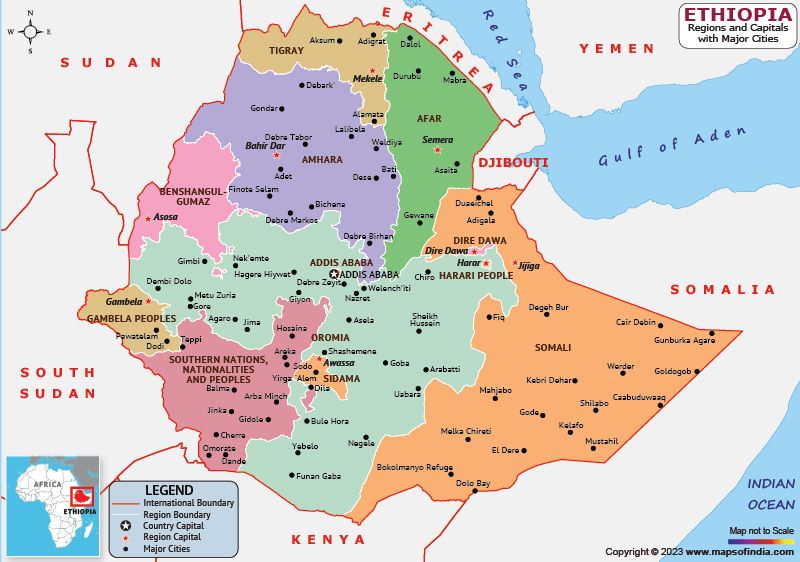
Ethiopia regions and capitals with major cities
Introduction
When Abiy Ahmed came to power in 2018, millions of Ethiopians believed a new democratic chapter had begun. They were excited that at last, change was coming their way and hope was restored. Media restrictions were temporarily loosened, political prisoners released and exiled opposition groups returned home. However, the transition had a few gaps that wouldn't go unnoticed - credible national language, durable pact among the elites, and shared constitutional settlement capable of managing deep ethnic and regional cleavage. The reform moment was there but the institutions to back it up and keep the hope alive were never built. The gap between between delivery and promise frames everything that follows.
Political Consolidation- From Reform to Recentralisation
With the growing authoritarian tendencies, violent ethnic conflicts, broadening distrust between the state and numerous communities and political fragmentation made the hopes for a reform to let up. Critics now argue that Ethiopia steered away from the promise of democratic practices into an increasingly centralised political system dominated by the ruling Prosperity Party. The 2025 Freedom House confirms that authorities engaged in a pattern of harassment, restrictions, detentions, barely leaving the opposition with room for meaningful political participation. Journalists working for independent outlets risk being arrested arbitrarily and face incommunicado detention. For instance, in August and September 2025, at least six journalists and media workers were arbitrarily detained. In April 2025, police raided Addis Standard's newsroom, detained three managers and seized devices. All these goes beyond centralised authoritarian order towards questioned authority, disintegrated security and recurrent coercion.
Federal Dynamics- The Ethnic Fault Lines That Won’t Sit Still
Over the past two years, Ethiopia's government has gone through a series of compounding security challenges. With a peace agreement signed in November 2022 to end the Northern Ethiopia's conflict across Tigray, Amhara and Afar regions, it prevented a return of the widespread conflict despite the resurgent clashes. Conflict related insurgencies in the Oromia and Amhara regions has fluctuated over the past two years leading to widespread destruction and loss of life. Neither the Fano in the Amhara region nor Oromo Liberation Army of Oromia region has been able to establish control over the significant amount of territory.
The conflict in Amhara began as minority clashes that escalated into a full scale insurgency by August since April 2023 when Fano tried to control the region’s major cities by launching a coordinated attack. The violence displaced more than 100,000 people with 4.7million children left out of school. In Oromia, the conflict escalated when the government exercebated its efforts against the Oromia Liberation Army as violence spread closer to Addis Ababa. Simultaneously, conflict found its way back to Tigray for the first time since 2022 demonstrating failure to enforce the provisions of disarmaments of the Pretoria Agreement.
The period leading up to the elections in 2026 is defined by a clash between Abiy Ahmed’s ideology - a centralisation project - as critics would say, and the ingrained constitutional reality of ethnic federalism. This ideological dissonance has alienated constituencies that once formed the prime minister's support base, leaving the centre increasingly isolated and reliant on coercive force to maintain order.
The 2026 Elections - Accountability or Insulation
Despite the worsening security crisis across Tigray, Amhara and Oromia, Ethiopia's elections are set to proceed in June, and rather than test it, they are positioned to integrate a one party rule under the Prosperity Party. Both the government and the TPLF continue to accuse each other of violating the 2022 peace deal terms that ended then two year civil war could potentially result to further instability and accusations of illegitimacy.
A report by the International Institute for Democracy and Electoral Assistance (IDEA) on May 2025 agrees further, that withbthe upcoming elections risks building political mistrust. It also highlights how the acute regional insecurity influences the electoral environment as with the recurring conflicts in Tigray and Amhara aligned forces encroaching in border disputed regions challenging the thinly veiled peace with fears to relapse into a large-scale war. In such cases, attempts to make an agreement within these regions should be made on power competition amongst the influencers, but thats absent.
Recent Reforms - Real Moves, Uneven Implementation
On the economic front, Ethiopia has been making significant structural moves. Following the agreement made in July 2024 with the IMF in exchange for a USD 3.4 billion funding program, the government committed to restoring debt sustainability, creating a stock exchange, liberalising the exchange rate, and gradually opening the economy to private investors. The Banking Business Proclamation of March 2025 extended this further by allowing foreign ownership of upto 49% of Ethiopian institutions for the first time opening a previously closed sector.
In addition, the Grand Ethiopian Renaissance Dam was inaugurated in September 9, 2025 - Africa’s largest hydroelectric project with a maximum generation capacity of 5,150 MW - attended by several regional leaders including Somalia’s President Hassan Sheikh Mohamud. The inauguration symbolised both an energy milestone and national sovereignty. Ethiopia is also advancing its WTO accession, with bilateral negotiations held in March 2024 and planning to join in 2026, resuming a process that originally began in 2003.
Despite the government relaunching the Securities Exchange, opening new sectors and floating the birr, investor cinfidence remains Constrained. Weak property rights, persistent instability and heavy state dominance proceed to compromise investment environment. The US Department of State's 2025 Investment Climate Statement concluded: “The government insists it is eager to attract FDI but has mostly failed to address the many shortcomings that deter foreign interest."
Fiscal Policy and Economic Pressures
Ethiopia's economy is expected to grow by 10.2% in the current fiscal year according to Prime Minister Abiy Ahmed. However, the contrast in figures between the prime minister’s statement, IMF and the UN reflects the governance credibility gap as the figure is revised to be 9.3% and 7.2% respectively.
Inflation has improved, declining towards 11.9% in 2025/26 and hopefully to a single digit over the medium term from a 32.5% in 2022/23. By December 2025, a decline of inflation had been recorded at 9.7%, though on selected items. Government revenue mobilisation has improved significantly, with revenue projected to rise to 10.5% of GDP in 2025/26 from 7.3% in 2023/24, supported by recent tax policy reforms and improved administration. External budget support is expected to decline to about 0.5% of GDP over the next two years from 1.5% in 2024/25 due to confined fiscal financing limits scope for expenditure growth. Post-restructuring external debt service obligations will add additional pressure on financing once bilateral agreements are finalised.
Trade, Investment Climate and Horn of Africa Stability
Ethiopia's reserves had remaned below one month of import coverage from November 2021 through June 2024, before it's reforms. Upon the liberalization of the exchange rate, reportedly the reserves began to rose to about USD 4 billion in April 2025, covering nearly 2 months of prospective imports according to the IMF.
The first phase of development of the Bishoftu international airport began on January 10, 2026, aimed to complement the existing Bole airport which was ranked third of the busiest airports in Africa in 2025. The price tag of USD 10-12.5 billion underscores the scale of Ethiopia's infrastructure ambition.
The GERD was inaugurated in 2025 without a binding water agreement with downstream countries. Egypt calls the Nile a “matter of existence, not subject to compromise" as it provides almost 97% of Egypts renewable water supply and any disruption threatens food production and rural livelihood - risking water security and regional stability. With the absence of a trilateral binding agreement between the Egypt, Sudan and Ethiopian governments on filling, operation of the dam and potential dispute remains a geopolitical fault line.
A Research unit by Yale University in April 2026 reported with high confidence that Ethiopia is providing support to Sudan’s paramilitary Rapid Support Forces, citing satellite imagery of paramilitary vehicles at a military facility in the Benishangul-Gumuz region near the Sudanese border. Addis Ababa has rejected the claims but adding to growing concerns about growing instability along the Ethiopia-Sudan border.
Investor and Regional Partner Risk Assessment
The 2024 currency float saw the birr lost over 100% of its value, constricting the parallel market gap before it reopened months later, with a gap between the parallel rate and bank exchange rate re-emerging in November 2024. Despite the reforms, investors report the excessive tax rates, inefficient logistics system and retroactive customs rules. Foreign companies are often required to lease equipment from state-owned owned enterprises compromising the credibility of privatisation commitments.
Ethiopia’s expanding diplomatic influence, including preparations to host COP 32 in 2027 and growing involvement in climate and water security discussions, depends on international partners remaining focused on cooperation. With the upcoming Invest in Ethiopia 2026 Forum gathering over 800 investors and development partners, developments in the Gulf and the neighbouring conflict zones have a direct influence on the overall investment profile and economic resilience of Ethiopia.
The 2026 elections carry consequences that makes it less of a domestic affair. Now that combined with internal fragmentation and electoral uncertainty, risks being a geopolitical standpoint for regional rivalries playouts through local proxies. Chances are high that regional tensions could break out to a wider conflict.
Policy Recommendations
1.Electoral Credibility and Civic Space Protection: Given the documented pattern of opposition suppression and media restrictions, the credibility of the elections genuinely depends on an independent oversight. The government should invite international election observes early and commit to binding recommendations. While at that, civic space must be protected as a precondition for any legitimate electoral outcomes.
2. Fiscal Rebalancing Toward Capital Expenditure: The recurrent expenditure and capital investment towards debt servicing structural shift poses a threat towards Ethiopia’s longterm development trajectory. With the upcoming of major investment forums as well as the IMF support, the government should commit to a credible capital expenditure framework that demonstrates the active use of incoming investment.
3. Federal Conflict De-escalation and Ethnic Militia Integration: following the recurring insurgencies in Tigray, Oromia and Amhara, not only does it indicate a humanitarian crisis but also an economy dependent on regional stability impeding investor confidence. A structured inclusive dialogue process, including all armed groups, is necessary. Integration of the militia into a unified national security framework should be treated as a priority.
4. Foreign Exhcnage Stabilisation and Investment Environment Predictability: with the retroactive customs rules as well as the re-emergence of the parallel exchange rate gap, indicates inconsistencies in implementation despite the headlines compromising investors’ confidence. To improve Ethiopia’s investment environment, the most actionable thing to be done is ensuring there’s regular predictability especially on clear privatisation timelines and transparent licensing.
Outline
As Ethiopia approaches its 2026 elections, it stands at one of the most politically fragile moments in modern history. What should be a democratic exercise for national legitimacy has been centred on fear, controversy and political polarisation. Centralisation of power without accountability only makes a state more fragile in stability - the kind that only holds for a while. The upcoming elections will attest to it. What follows will define Ethiopia’s trajectory for the decade and the Horn’s stability.